
WEMBLEY · HA0 & HA9
About Complete Mould Removal Wembley
A clear approach to mould, damp and moisture enquiries in Wembley. The starting point is the affected property, the evidence available and an agreed next step.

Which areas do you cover?
Enquiries are welcome from Wembley, HA0 and HA9. Describe your property and access arrangements when you call so the proposed service can be discussed.
How do I choose between inspection and removal?
Describe what you can see and whether moisture or growth keeps returning. The suitable starting point depends on the information available, material condition and the question that needs resolving.
The problems we discuss with customers
Complete Mould Removal Wembley handles enquiries about mould, damp and related moisture conditions in residential property. Customers may notice growth around a window, repeated marks behind furniture, dampness following a leak or a room that stays wet after normal use. These symptoms may look similar in photographs while requiring different questions and next actions.
The service list is deliberately specific: mould removal, mould inspection, damp inspection, condensation investigation, condensation and ventilation assessment, hidden leak detection, and external water and gutter issues. It does not imply a general building or repair service. If the concern falls outside those areas, or needs another contractor, the proposed scope should make that distinction clear before work is agreed.

Begin with the property, not a preset answer
A useful discussion starts with where the problem appears, when it began and what has already been tried. The location and pattern of a mark can help guide an assessment, but neither a photograph nor a short telephone description proves the cause. The condition of the material and the surrounding room matter as well.
This approach avoids assuming that every black mark needs the same treatment or that every damp area comes from condensation. The next step should follow the available evidence. Where information is incomplete, it is better to define the question for an inspection than to present an early possibility as a confirmed diagnosis. Customers should understand which conclusion is established and which remains provisional.

Inspection and treatment answer different questions
Mould inspection considers visible growth, affected surfaces and the conditions that may contribute. Mould removal concerns the appropriate treatment of affected material within an agreed scope. One does not automatically include every element of the other, and neither should be confused with repair of a hidden water source.
The distinction matters when arranging work. Treating a visible area may not resolve an ongoing leak or unsuitable ventilation arrangement. Conversely, source work does not automatically restore damaged finishes or address remaining contamination. Ask what the proposed service covers, what condition is expected afterwards and whether another action is recommended before treatment begins. A clear description is more valuable than a broad promise that everything will be dealt with.

Why moisture conditions matter
Visible mould often leads the enquiry, but the surrounding moisture conditions influence the next decision. Condensation around a window, water entering through an external detail and residual dampness after a leak can require different investigations. Several conditions can occur together, so the presence of one symptom should not prevent consideration of other evidence.
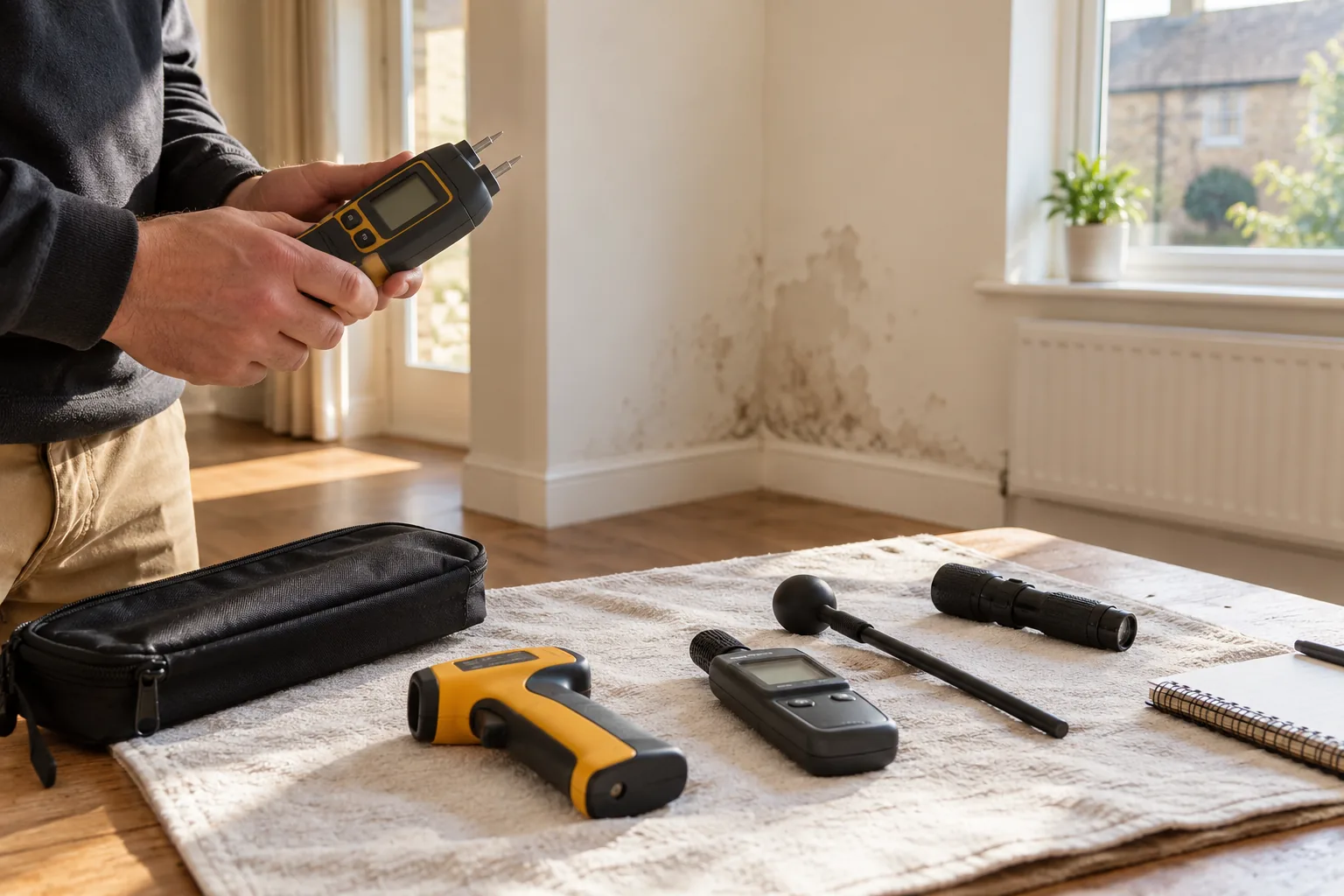
An assessment should explain how the visible pattern relates to a possible source and what would be needed to confirm it. Measurements, where appropriate and agreed, need interpreting with the material and conditions. An isolated reading or a dry surface during a visit does not answer every question. Customers should be told about these limits so they can make a sensible decision about further investigation or treatment.
Choose the service around the decision needed
If the main question is why a wall is damp, damp inspection may be a useful starting point. If the concern is repeated window moisture, condensation investigation may help examine its timing and setting. Where the uncertainty concerns extraction and air routes, the ventilation assessment has a different focus.
A concealed source may justify hidden leak detection, while visible rainwater concerns can call for assessment of external water and gutter issues. These are not interchangeable labels for an identical visit. Explain the symptom and ask what the proposed service will help establish. There is no need to diagnose the property yourself or order several services without understanding why each is relevant to the concern.

What to expect before a visit
The initial conversation should establish the property location, affected rooms, approximate extent of the issue and any known history. Explain whether the problem is new, returns after cleaning or follows a particular event. Previous repairs and recent changes to the building or room use may also be relevant, even when their connection to the current concern is uncertain.
Access needs should be discussed in advance. A patch behind a large wardrobe, an inaccessible ceiling or an external feature high above ground can change the scope. Ask what preparation is needed rather than moving heavy furniture or disturbing finishes without advice. Before confirming a visit, clarify the proposed work, how findings will be communicated and any known limitations.

What an assessment should make clear
Customers need to understand what was examined, what was observed and what those observations can support. A useful finding separates a visible condition from a suspected cause. It should identify inaccessible areas and explain whether further checks are needed before treatment or repair decisions can be made. Uncertainty should be stated plainly rather than hidden behind technical terms.
Ask whether photographs, measurements or a written record are included in the agreed service. These should not be assumed from a service name. If recommendations involve another contractor, clarify what issue that contractor needs to investigate. The purpose is to support the next decision, not to provide a list of unrelated changes or promise that one action will resolve every concern in the property.
Treatment planning should reflect the material
A sound washable surface differs from a damaged absorbent finish. The extent of visible growth, the material condition and ongoing moisture risk all affect what may be appropriate. A treatment plan should describe the scope and its limits, including any finish that may remain stained or any material requiring further discussion. Specific products or machinery should only be stated once confirmed for the work.
Preparation also depends on the area and occupancy. Access, nearby belongings and any necessary restrictions should be agreed before work starts. Customers should know what is included on the day and which follow-up actions remain their responsibility or need another contractor. No fixed result, drying period or guarantee is claimed on this page.
Working with property access and responsibilities
The person arranging the service should explain who is responsible for the property and who can authorise access. In rented or shared buildings, relevant information may sit with an owner, managing agent or another occupier. A moisture concern can involve more than one room or part of the building, and the investigation may be limited if necessary areas cannot be accessed.
The service does not automatically include permission to open finishes, enter neighbouring property or undertake repair work. These matters need discussing before the scope changes. Share the practical details early so that the next step can be planned around the actual access available. A clear record of earlier work and observations can help reduce repeated questions and unnecessary assumptions.
Recommendations that can be used in everyday life
Advice should relate to the findings and be realistic for the household. Reviewing an existing air route, considering separate fan assessment and arranging investigation of water entry are different recommendations. Each should have a stated purpose. Customers should be able to see how the proposed action connects with the symptom rather than receive generic advice that could apply to any home.
Explain restrictions such as security concerns, limited window access or heating arrangements during the discussion. Where installation or repair is needed, an appropriate contractor should confirm the work. There is no basis for promising that a simple household change will prevent all recurrence. The useful question is what should improve and what evidence would justify a review if it does not.
Following up a recurring problem
If growth or dampness returns, note the position, timing and conditions rather than simply repeating the earlier treatment. A patch returning beside the same window may raise a different question from a new mark near an external wall. Describe any source work or ventilation changes completed since the original visit, including whether the symptom improved temporarily.
A return of visible growth does not establish that the same cause remains, and a cleaner appearance does not prove moisture has been resolved. Follow-up should be considered against the agreed scope and the new evidence. Where material damage remains, reinstatement may need separate planning. The next action should be proportionate to what is observed and what is still uncertain.
Serving Wembley, HA0 and HA9
Local coverage means enquiries can be discussed for homes across Wembley and the HA0 and HA9 postcode areas. It does not imply an invented office address, fixed attendance time or a promise of immediate availability. Confirm your postcode, the property type and access arrangements when calling so the relevant service can be considered.
Call +44 20 3966 3944 or use the information on the Contact Us page to prepare for the conversation. There is no contact form and no requirement to write a technical diagnosis. A clear description of the affected area is enough to begin discussing a suitable next step and the information needed before booking.
Questions before arranging a visit
Do you carry out every repair identified during inspection?
No repair scope should be assumed. Building, roofing, plumbing and electrical work need separate confirmation with an appropriate contractor.
Do I need to know the cause before calling?
No. Describe the location, appearance, timing and any previous work. The purpose of an assessment is to clarify the relevant question and next action.
Will an inspection always give a definite answer?
Access restrictions, concealed materials and intermittent conditions can limit conclusions. These limitations should be explained alongside any useful findings.
Are the website photographs completed customer projects?
No. Images are generated illustrations of relevant property conditions and work settings. They are not testimonials, before-and-after evidence or records of customer jobs.
Where can I discuss a booking?
Call +44 20 3966 3944 with your Wembley postcode and a short description of the issue. Confirm scope and practical arrangements before accepting a booking.
Discuss your property
Call +44 20 3966 3944 to describe the affected area and agree the next step. Enquiries are welcome from Wembley, HA0 and HA9. Photography is AI-generated illustration, not evidence of completed customer work.